


pixelPATT
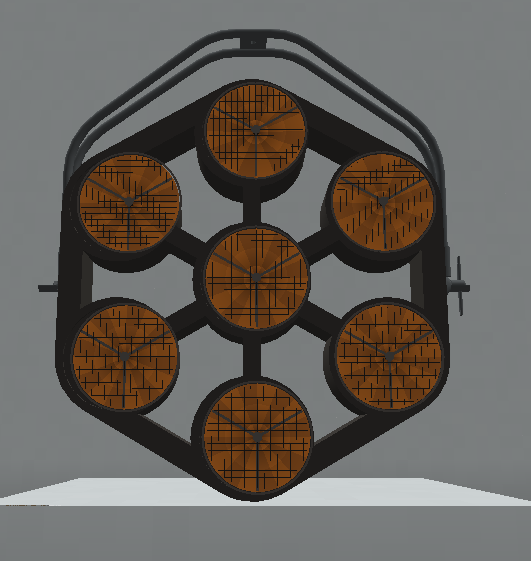

The pixelPATT is a static RGBW pixel luminaire implemented in Theatrical: Realistic Pack (TRP).
It contains seven individually represented RGBW reflectors / pixels and operates through TRP’s PATT Driver system.
Unlike conventional independently patched TRP fixtures, pixelPATT acts as a passive output fixture. The PATT Driver receives the Theatrical network and DMX data, processes the selected personality and distributes the resulting output to every linked pixelPATT.
Depending on the selected Driver personality, the seven elements can operate together or receive individual pixel control.
Official Resources
ROBE Product Page — pixelPATT™
ROBE pixelPATT™
ROBE describes the real pixelPATT as a seven-element RGBW pixel-controlled member of the PATT family using a remote PATT Driver for power and data.
Overview
| Manufacturer | ROBE |
| Fixture Type | Static RGBW Pixel / Effect Luminaire |
| Light Source | RGBW |
| Pixels / Reflectors | 7 |
| Direct DMX Input | ❌ No — controlled through PATT Driver |
| PATT Driver Required | ✅ Yes |
| Maximum Driver Distance | 10 blocks |
| Maximum Fixtures per Driver | 16 |
| Manual Pan / Tilt | ✅ Yes |
| Free Placement | ✅ Yes |
| Truss Mounting | ✅ Yes |
| Truss Mount Tool | ✅ Yes |
| Focus Tool | ❌ No |
| Custom Gobos | ❌ No |
| RoboSpot | ❌ No |
| FollowMe | ❌ No |
| Dedicated Flight Case | ❌ No |
| Survival-Friendly Carrying | ❌ No |
DMX Modes
pixelPATT does not independently decode its DMX input.
Its linked PATT Driver handles the DMX universe, address and personality, then sends the resulting output to the connected pixelPATT fixtures.
The PATT Driver provides seven personalities for the RGBW PATT family:
| Mode | Personality | Channels |
|---|---|---|
| Mode 1 | Wash | 13 |
| Mode 2 | Pattern | 32 |
| Mode 3 | Pixel RGB | 40 |
| Mode 4 | Pixel RGBW | 47 |
| Mode 5 | Pattern Full RGB | 53 |
| Mode 6 | Pattern Full RGBW | 60 |
| Mode 7 | Pixel RGBW Only | 28 |
Mode 1: Wash is the default personality.
These personalities belong to the PATT Driver control system rather than to an independently patched pixelPATT.
Implemented Functions
Depending on the personality selected on the PATT Driver, pixelPATT can reproduce functions including:
- Global RGBW colour
- Global intensity
- Shutter / strobe behaviour
- Individual pixel control
- RGB pixel control
- RGBW pixel control
- Patterns
- Pattern colour
- Active zones
- Colour mixing
- Colour macros
- CTC / white-point behaviour
- Transition effects
The exact set of available controls depends on the active PATT Driver personality.
Pixel Layout
pixelPATT contains:
7 individually represented RGBW pixels / reflectors
The Driver output is distributed to these seven visual elements.
In simpler personalities, the fixture can operate primarily as a combined output.
Pixel-oriented personalities allow the individual elements to receive independent colour data.
This makes pixelPATT particularly suited to:
- Pixel effects
- Colour chases
- Pattern-based output
- Decorative eye-candy looks
- Individually animated RGBW elements
within the capabilities of the selected PATT personality.
PATT Driver
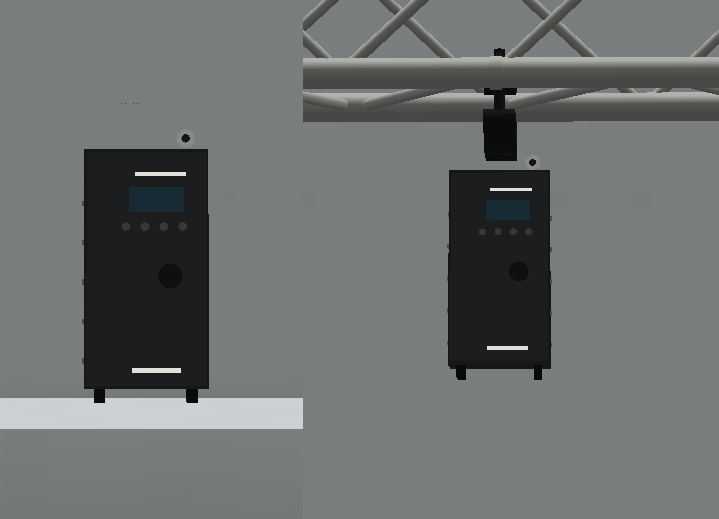
pixelPATT requires a PATT Driver for normal controlled output.
The Driver manages:
- Theatrical Network
- DMX Universe
- DMX Address
- Active personality
- Linked PATT fixtures
- Incoming DMX decoding
- Distribution of the resulting lighting data
The PATT Driver itself does not generate a fixture beam.
Linking to a PATT Driver
The PATT Driver scans for compatible nearby PATT fixtures.
The maximum connection distance is:
10 blocks
measured using the Driver’s spherical cable range.
A single Driver can control up to:
16 fixtures
at once.
Same-Model Requirement
All fixtures connected to one PATT Driver must be the same PATT model type.
For example:
PATT Driver
├── pixelPATT
├── pixelPATT
├── pixelPATT
└── pixelPATT
✅ Valid
The following configuration is not permitted:
PATT Driver
├── pixelPATT
├── PATT 2017
└── HolyPATT
❌ Invalid
A single Driver selection cannot mix:
- PATT 2017
- pixelPATT
- HolyPATT
Driver Ownership
A pixelPATT that is already linked to another PATT Driver cannot simultaneously be selected by a second Driver.
The PATT Driver target list identifies nearby fixtures that are already controlled by another Driver.
This ensures that only one Driver controls a particular pixelPATT at a time.
Link Persistence
PATT Driver links are persistent.
If a pixelPATT temporarily becomes unloaded, the link can be restored once the relevant blocks become available again, provided:
- The original Driver still exists.
- The fixture is still within the allowed range.
- The target remains compatible.
Unlinked Behaviour
A pixelPATT without a valid PATT Driver connection does not produce its normal Driver-controlled output.
Interacting with an unlinked PATT fixture can provide a configuration message indicating that a valid Driver link is required.
Fixture Configuration
pixelPATT differs from most conventional TRP fixtures because its primary network and DMX configuration is located on the PATT Driver.
The Driver stores:
- Theatrical Network
- Universe
- DMX Address
- Personality
- Linked fixture targets
The pixelPATT itself acts as the physical RGBW pixel output for this configuration.
PATT Driver Interface
The PATT Driver screen displays nearby PATT fixtures together with information such as:
- Model
- Block coordinates
- Distance from the Driver
- Link state
- Whether another Driver already controls the fixture
- Model compatibility with the current Driver selection
Players can select or deselect compatible pixelPATT fixtures from this list and save the configuration to the server.
Manual Aiming
pixelPATT is a static luminaire rather than a motorised moving head.
It supports manual Pan / Tilt adjustment for physically aiming the fixture.
This physical orientation is separate from the PATT Driver’s DMX output.
The Driver controls the lighting behaviour while the fixture’s manually configured orientation determines the direction of its output.
Free Placement
pixelPATT supports TRP’s Free Fixture Placement system.
When used on an ordinary horizontal surface, the fixture can be positioned according to the exact cursor location rather than being forced to the centre of a Minecraft block.
Before placement, TRP renders a preview using the actual fixture model.
The preview indicates whether placement is valid:
- Green / teal — valid
- Red — obstructed
The resulting placement stores its complete pose persistently, including:
- Position offset
- Yaw
- Pitch
- Roll
The fixture body, collision, optical origin, beam, projection and related lighting calculations all use the same saved transform.
The 0.15.X update also includes corrected initial orientation specifically for the new PATT-family models.
Focus Tool
pixelPATT is not compatible with the Focus Tool.
Its physical aiming is handled through its own manual Pan / Tilt adjustment.
RoboSpot
pixelPATT is not compatible with RoboSpot.
It cannot be selected as a RoboSpot camera or operated through the remote followspot system.
FollowMe
pixelPATT is not compatible with FollowMe.
It cannot be selected by a FollowMe Tracker as an automatic tracking fixture.
Custom Gobos
pixelPATT does not implement TRP’s serviceable gobo system.
It therefore does not support:
- Gobo Service Screwdriver
- Factory gobo replacement
- Custom engraved gobos
Flight Cases
pixelPATT has no dedicated functional TRP Flight Case in the current implementation.
This refers specifically to TRP’s interactive Flight Case system.
Survival-Friendly Carrying
pixelPATT is not included in TRP’s Survival-Friendly physical carrying system.
It does not use the carried-fixture entity workflow implemented for supported TRP fixtures.
Rigging & Mounting
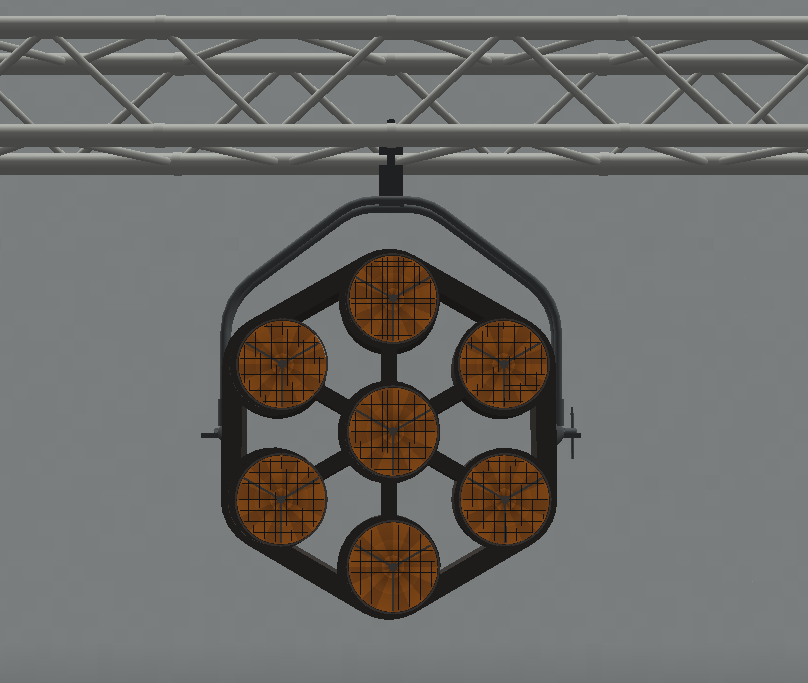
pixelPATT supports TRP’s compatible rigging infrastructure.
It can be used with:
- F34 truss
- Compatible Theatrical truss / rigging structures
- Recognised compatible support systems
- Free placement on ordinary supported surfaces
It also supports the Truss Mount Tool.
Truss Mount Tool
On a valid horizontal F34 side mount, the Truss Mount Tool can adjust the physical installation angle of pixelPATT.
The available mounting-angle range is:
0°–120°
in:
15° increments
The tool also supports switching between:
- Rail A
- Rail B
when the selected support provides both rails.
These settings control the physical rigging orientation and should not be confused with DMX Pan / Tilt